What Is a Keyword Density Checker? How It Works & How to Use One (2026)

Understanding Keyword Density in Simple Terms
A keyword density checker helps you understand how frequently a word or phrase appears in a piece of content. Learn what keyword density means, how the calculation works, what the percentage can tell you, and why there is no single “perfect” density for every page.
What Is a Keyword Density Checker?
A keyword density checker is a content-analysis tool that counts how often a particular word or phrase appears in a text and compares that number with the total word count. The result is usually expressed as a percentage.
In simple terms, it answers a useful editorial question: “How heavily am I repeating this word or phrase in my content?”
This can be useful when reviewing an article before publishing, especially when you want to catch accidental repetition or make sure an important topic is actually represented in the copy.
Want to Check Your Own Content?
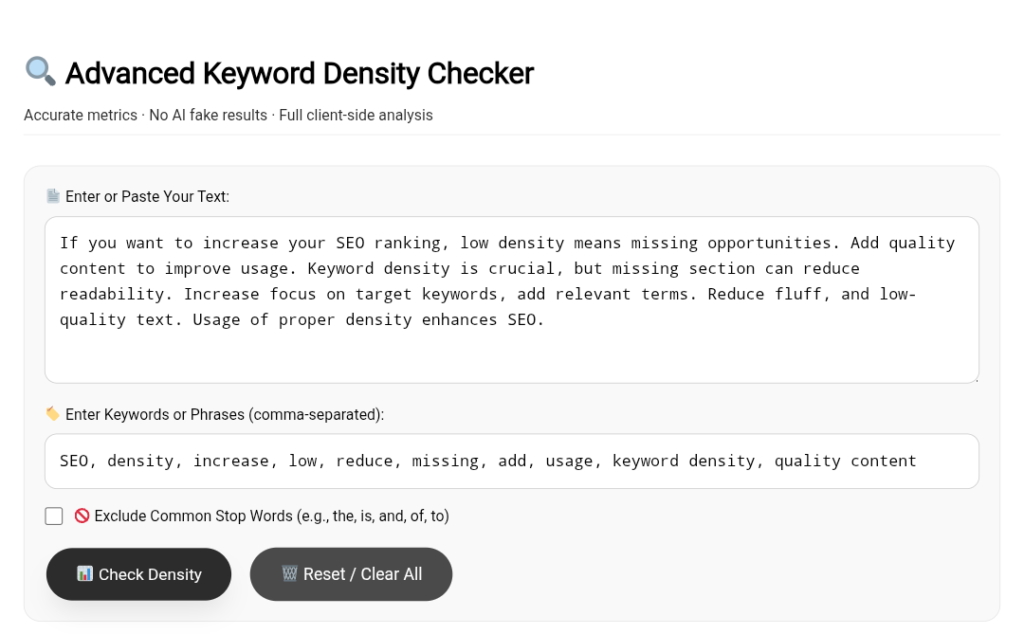
If you want to see the numbers instead of calculating them manually, you can use our free keyword density checker . It analyzes your text directly in the browser and can report target keyword counts, density percentages and frequent 1-word to 4-word phrases.
How Does a Keyword Density Checker Work?
The basic calculation is much simpler than many people think. A checker counts the occurrences of a selected word or phrase and compares that count with the total number of words being analyzed.
For example, if a 1,000-word article contains a target phrase 15 times, the basic calculation is 15 ÷ 1,000 × 100, giving a density of 1.5%.
The percentage is therefore a measurement of repetition. It is not a score from Google, and it does not mean that a page becomes more relevant simply because a particular percentage is reached.
What Can Keyword Density Tell You?
Density can be useful as a quick content-quality check. It can reveal whether a particular term appears much more often than you expected, or whether a phrase you intended to cover barely appears at all.
Is There an Ideal Keyword Density for SEO?
There is no universal keyword-density percentage that guarantees better rankings. Different topics, page types, search intents and writing styles naturally produce different word frequencies.
Instead of trying to hit an exact number, use density as a reference point. If the same phrase is appearing repeatedly in almost every sentence, read the content aloud and ask whether the repetition actually helps the reader.
Google specifically describes excessive repetition of words or phrases that sounds unnatural as keyword stuffing. You can read the official explanation in Google Search’s spam policies .
Keyword Density vs. Keyword Stuffing
These two ideas are not the same. Keyword density is simply a measurement. Keyword stuffing is a writing practice where keywords are repeated excessively or unnaturally in an attempt to influence search visibility.
A page can have a particular percentage without being problematic, while another page can sound unnatural even without reaching a specific mathematical threshold.
That’s why the better approach is to write naturally first and then use a keyword density analysis as a review step.
What Are N-Grams in Keyword Analysis?
An N-gram is a continuous sequence of words. Looking at N-grams can help you see repeated phrases that a simple single-word count might miss.
| Type | Example | What It Shows |
|---|---|---|
| 1-word | keyword | Single-word frequency |
| 2-word | keyword density | Common two-word phrase |
| 3-word | keyword density checker | Repeated three-word phrase |
| 4-word | free keyword density checker | Longer repeated phrase |
N-gram analysis is particularly useful when reviewing longer articles, because repeated phrases can become noticeable even when individual words do not appear unusually often.
How to Use a Keyword Density Checker
Add the article, paragraph or other text you want to review.
Add the keywords or phrases you want to check, separated by commas.
Check occurrences, density percentages, word statistics and frequent 1-word to 4-word phrases.
If you want to perform this analysis immediately, try the Toolstwenty Keyword Density Checker .
Why Do Some Keyword Density Tools Exclude Stop Words?
Stop words are very common words such as “the,” “is,” “and,” “of,” and “to.” They appear naturally in almost every piece of English writing.
Removing these common words can make frequency analysis more focused on content words and phrases. However, the resulting percentage can differ from the percentage calculated using the complete text because the total word count changes.
Does Browser-Based Keyword Analysis Matter?
For a simple text-analysis task, client-side processing can be useful because the calculation can happen directly inside your web browser rather than requiring an external analysis API.
The Toolstwenty checker performs its density calculations in the browser. It does not require an API key for the analysis, making it convenient for quickly reviewing text.
When Should You Check Keyword Density?
You do not need to check every sentence while writing. A better workflow is to finish your draft first and then use frequency data as a final review.
- Before publishing a long-form article
- When a target phrase feels repetitive
- When reviewing an existing page after an SEO update
- When comparing the frequency of several important phrases
- When you want to discover repeated multi-word phrases
The numbers should support your editing decisions, not replace judgment about readability, search intent or usefulness.
Common Keyword Density Mistakes
1. Chasing a specific percentage
Treating one number as a ranking formula can lead to unnatural writing. There is no universal percentage that works for every page.
2. Repeating the exact keyword everywhere
Good content can naturally use variations, related terminology and contextually appropriate language instead of repeating the same phrase.
3. Ignoring the reader
If a sentence sounds awkward simply because a keyword was inserted, rewrite the sentence for the reader.
4. Comparing different tools without checking methodology
Different tools may count words, punctuation, stop words and phrases differently. Small differences in results are therefore possible.
Frequently Asked Questions
What is a keyword density checker?
It is a tool that counts how often a word or phrase appears in text and calculates its frequency as a percentage of the analyzed word count.
What is a good keyword density for SEO?
There is no universal ideal percentage. Use density as a reference for reviewing repetition rather than trying to reach a fixed SEO number.
Does Google use keyword density as a ranking score?
Keyword density is not a public Google ranking score. It is better viewed as a content-analysis measurement that can help you review repetition.
What is keyword stuffing?
Keyword stuffing is excessive or unnatural repetition of keywords or phrases intended to manipulate search visibility. Natural writing should always come first.
Can keyword density be 0%?
Yes. If the selected word or phrase does not appear in the analyzed text, its density will be 0%.
Why can two keyword density tools show different percentages?
Tools may use different rules for counting words, punctuation, stop words, capitalization or phrases. Always compare results using the same methodology.
What are N-grams?
N-grams are continuous sequences of words. A 1-gram contains one word, a 2-gram contains two words, and so on.
Does the Toolstwenty checker require an API key?
No. Its keyword-density calculations run directly in the browser and do not require an API key.
Check Your Content Before You Publish
Keyword density is not a magic SEO formula, but it can be a useful diagnostic when reviewing content. Use the numbers to spot repetition, examine common phrases and make your writing more natural.
Check Keyword Density Free